

EMPLOYER BENEFITS – What You Need to Know
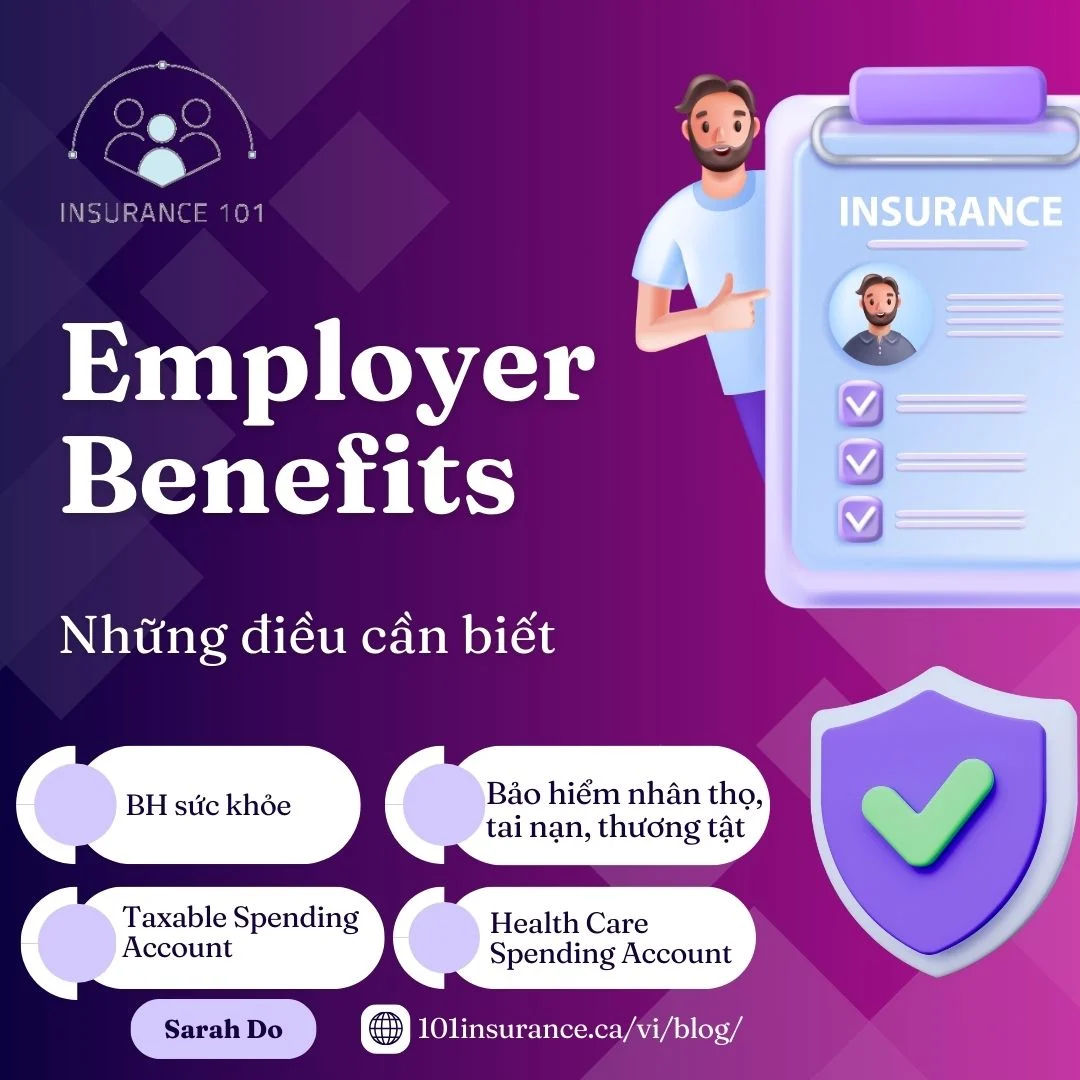
Table of Contents
- 1. What do company benefits usually include?
- 2. Understanding health-related benefits in detail.
- 2.1. Health insurance
- 2.2. What does company health insurance usually cover?
- 2.3. Other common items besides health insurance
- a. Life, accident and disability insurance
- b. Taxable Spending Account (Wellness account)
- c. Health Care Spending Account (non-taxable)

On a whim today, I sat down to review my husband’s company benefits and insurance to see if there is anything we haven’t used yet, so we can use it all up. So I took the opportunity to write a detailed article on the important points to know about employer insurance & benefits. Many people who work for a company receive benefits but don’t fully understand them or take full advantage of these benefit packages, so I think it is really necessary to write a detailed article on this topic.
1. What do company benefits usually include?
Alongside salary and bonuses, what many people who work for a company care about is benefits. These benefits can include the following common items
- Health insurance
- Retirement Saving Plans
- Paid Time Off
Can these benefits usually be negotiated? This part is a little off-topic whim of mine. Some of you may think that company benefits are policy, so they cannot be negotiated. But in reality, if you are a talent – in a position where you can hold your head high and negotiate – you can still negotiate them. This is from my husband’s experience. Specifically, the things he has negotiated include:
– Requiring health insurance to take effect immediately from the date the employment contract is signed. Normally, depending on the company, health insurance may only begin to take effect after the probationary period (probation time) or after 1 year from the date the official contract is signed. If you don’t negotiate, the company rules will apply by default. That means when you change jobs, you will lose your health benefits during this gap period.
– Requiring paid leave to be calculated for the full year or prorated from the time the contract is signed, instead of starting after the probationary period. Most companies will prorate the number of paid leave days according to when you start working. For example, if you have 12 paid leave days in a year and you start working in September, then that year you will only get 3 paid leave days.
Anyway, I’ll keep this negotiation part short before I drift too far off topic.
2. Understanding health-related benefits in detail.
2.1. Health insurance
First, I will briefly go over the most basic concepts that everyone needs to understand:
- Deductible: This is the amount of money you will pay out of your own pocket before the insurance company pays. This deductible is usually calculated per year. However, it can apply per person or to the whole family.
For example, the deductible in your insurance plan for prescription drugs is $100/person/year; and the company pays 80% of the cost. In that year, your family pays $500 for dad’s medication and $200 for your child’s. You will pay out of pocket $100 + 20% of $400 for dad -> a total of $180. Similarly, for your child, you will pay $120 out of pocket.
- Reimbursement levels: this is the percentage rate the company will pay after the deductible has been subtracted. This rate usually ranges from 80% to 100%. As in my example above with the 80% rate, you can look back at it. Usually, companies with a high reimbursement level will have a low deductible (or no deductible), and vice versa.
2.2. What does company health insurance usually cover?
The most basic things you will usually be covered for are:
- Hospital stay costs: Normally, provincial health insurance only covers a standard ward, i.e., a room with 4-6 beds. Whereas with company insurance, you can choose a semi-private room (2 beds/room) or a private room (a room all to yourself).
- Ambulance: because provincial health insurance usually does not cover ambulances, company insurance will usually cover 100%. A funny story: I remember one time my husband got so drunk that I couldn’t drag him into the car, so I had to call an ambulance to come and carry him away, and he spent a night in the hospital. The company insurance paid for everything =)) Don’t think this is unnecessary. When I called the ambulance, they advised that for someone with alcohol intoxication (severely drunk) whom you are not strong enough to handle, it can be dangerous: if that person vomits while lying down, it can lead to choking and cause death. Oops! I’m off topic again.
- Nursing costs
- Dental care
- Vision care: usually also covers prescription glasses
- Paramedical services: such as physiotherapy (Physiotherapist), speech therapist (speech therapy), Podiatrist/Chiropodist (foot care), massage therapist, Acupuncturist (acupuncture), Nutritionist (nutrition)… Take the time to read these carefully, because there are many things you can take advantage of without realizing it. For example, back when I worked in a nursing home, my job required standing for long periods, so my feet often hurt; only after a while did I learn that I could see a Podiatrist and order specialized insoles/shoes to relieve foot pain and have part of the cost covered. Or things you may need but don’t know you can use, such as speech therapy for your child if they are slow to speak (quite a few Vietnamese children born over here are slow to speak), or acupuncture when your body aches, etc…
- Medical costs while travelling (travel insurance): before buying personal travel insurance, you can check your company’s travel insurance plan to consider whether you need to buy it or not. For example, my husband’s company’s out-of-country travel insurance plan is really “crappy”: it only pays 50% with a maximum coverage of $3000 over a total of 3 years. That kind of plan is insurance just for show; how much does it actually cover :-<
- Some other medical costs that you may need but don’t realize you are insured for, such as: Fertility drugs (infertility treatment/fertility stimulation drugs), anti-smoking drugs/cessation programs, hair prosthesis (hair regrowth treatment), hearing aids, etc..
In short, you should take the time to read each item carefully. Because every time you change companies, you only read these once when you first join the company, so don’t begrudge the time to sit and read them.
2.3. Other common items besides health insurance
a. Life, accident and disability insurance
Understanding these types of insurance is very important. When I do financial assessments for my clients to buy personal life insurance, I always ask about these. Most group life insurance plans at a company will cover 1-2 years of the employee’s salary. And of course, this amount is usually not enough for the needs of an individual or a family. Because I don’t want this article to get too long, I will only summarize a few important points you need to know:
– Life/accident/disability insurance will end when you end your contract with the company. So the risk, if you rely entirely on company insurance without buying your own life insurance, can be: when you leave your job, your health condition may no longer qualify you to buy personal insurance (for example, if cancer is discovered), and you lose the ability to be insured.
– Insurance companies usually always give you the option to keep the company’s life/accident/disability insurance by continuing to pay the premiums yourself. However, you need to be aware that when you choose to extend, either the company will require you to provide insurability information (roughly, your current state of health), or it will charge you the default smoker rate if you do not provide proof of health.
– The advantage of group insurance is that if you decide to buy more (above the company’s standard plan), the premiums will be cheaper than buying a personal plan. You should usually choose this option when you or a family member has a health condition that makes it impossible to buy personal insurance.
b. Taxable Spending Account (Wellness account)
This is a type of benefit that helps employees pay for expenses related to health and lifestyle. Spending from this account can include:
- Gym, yoga or fitness class memberships (dance classes, swimming lessons…)
- Health support equipment (for example: smart watches, exercise equipment).
- Counselling or training programs on finance and mental health.
- Recreational and personal development activities (such as registering for courses, sports activities)..
Because this is a taxable account, when the company pays this amount for you, it will be considered part of your taxable income for that year. And note that this Taxable Spending Account is usually reset every year. That is, if you don’t use it this year, it will not be carried over to next year.
And remember, this can apply to the whole family. For example, this year I claimed my daughter’s dance class fees under this account.
c. Health Care Spending Account (non-taxable)
This is a type of account that pays for health care costs that provincial insurance or company insurance does not cover. In other words, the company helps cover part of what you would otherwise have to pay out of pocket. For example, if the company gives you $250/year, then in the example in section 2.1 above, this man could ask the company to reimburse $250 of the total $300 he had to pay. Unlike the taxable account above, this account is usually carried forward to the next year if you haven’t used it. But you need to pay attention to how long it is allowed to accumulate, so you can use it before it expires. The best way is still to use it all up each year and keep things simple.
At first I was going to write about RRSP matching benefits too. But I think this article is already too long, so I’ll stop and take a breath here :-< That’s simple enough that everyone can probably google it themselves.
Wishing you all a very happy end of the year! Take the chance to use whatever you can from your company insurance before the year ends! #SharingFromSarah #EmployerBenefits #GroupInsurance #101insurance
Related Articles

How Much Life Insurance Is Enough for a Family in Canada?
How much life insurance is enough: $250,000, $500,000 or $1 million? There is no single number that fits every family in Canada. Learn how to calculate your Insurance Needs based on your mortgage, debts, income that needs to be replaced, childcare costs and existing assets, so you can choose the right amount of coverage for your family.

Understanding University
The difference between an Institute and a University University, Institute and College are used interchangeably in the names of universities without following any particular rule. In American English, College means a university. In spoken and written Canadian English, College refers to vocational schools. But according to international standards, universities are divided into two types: Institutes ...

School Grades – Part 2: Elementary School Grades
Elementary School runs from kindergarten (age 4) to grade 8. The educational focus of this stage is nurturing and developing children's character, not transmitting complex scientific knowledge.