

Guide to Applying for an Open Work Permit for the Spouse and Dependent Children of an International Student
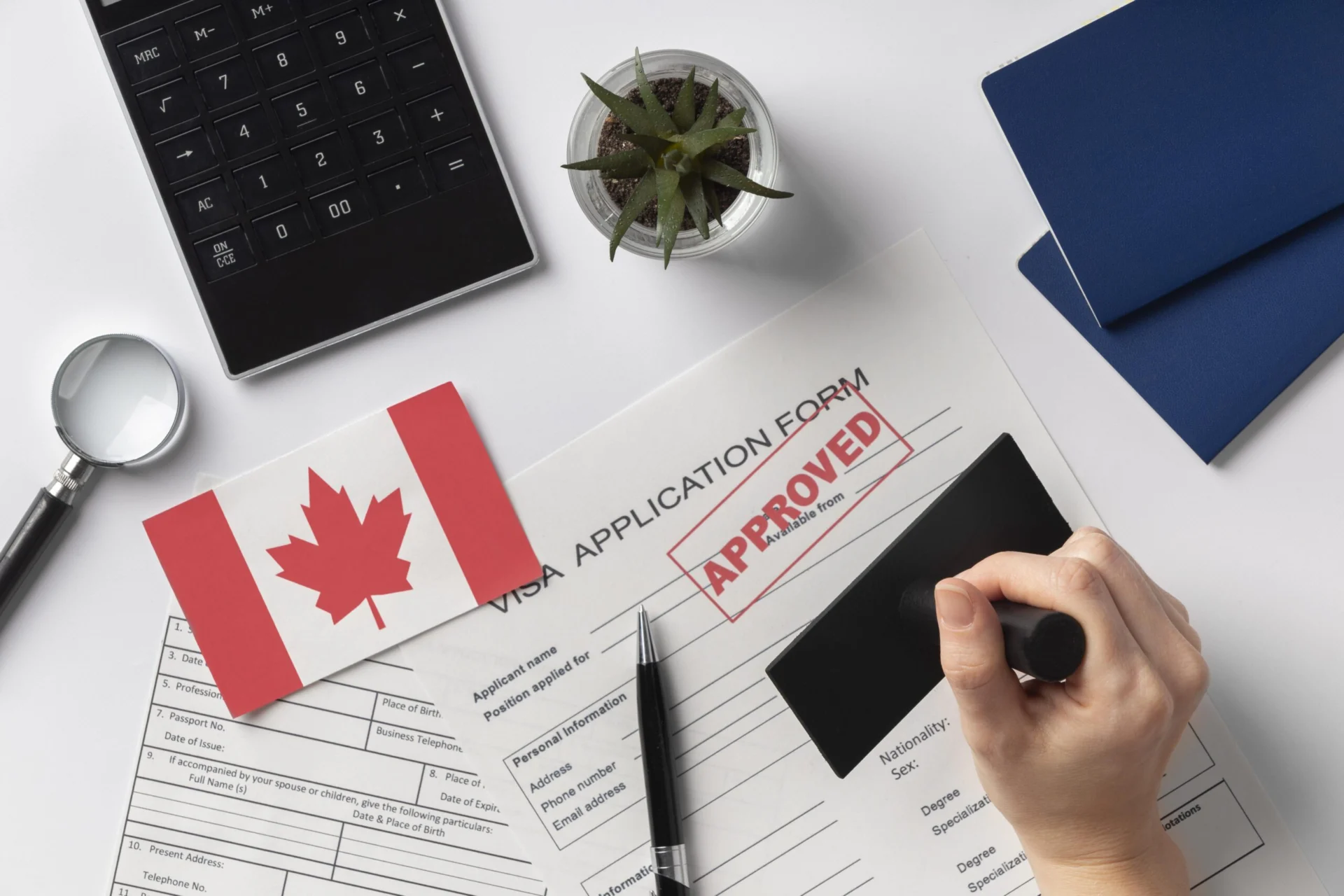
Table of Contents

This article is based on my own personal experience and that of others who applied for an OWP on their own for their spouse/children and succeeded; it is not affiliated with any agent. Please note the Disclaimer at the end of this article before you start preparing your application. And do not hesitate to inbox me if you have any questions or need help with anything related to the application. I will do my best to answer within my knowledge to help couples who are still longing for their Canadian dream 🙂 Good luck, everyone!
A- OWP – Paper application (offline)
1. The forms on CIC, including:
- Application For Work Permit Made Outside of Canada (IMM 1295) (PDF, 465.84KB)
- Document Checklist (IMM 5488) (PDF, 316.89KB)
- Family Information (IMM 5645 or IMM 5707)
=> Download these forms directly from CIC (using the link I provided above) as close as possible to the date you prepare to submit your application. Do not take forms from someone else and edit them, because CIC updates its forms from time to time.
=> Open the files and fill them in using the latest version of Adobe Reader. If you use Foxit or another app, you will run into many errors, or even errors when printing.
- LOE (letter of explanation)
- Curriculum Vitae
- Proof of medical exam – opt
- Certificate of Criminal Record No.2 (Vietnamese police certificate No. 2)
- Birth Certificate
- Family Register (household registration book)
- Certificate of Marriage
- Roman Catholic Family Book – optional
- Wedding’s Pictures – optional
- Degrees & transcripts (high school, university, and other certificates)
- Employment contract – optional
- Documents proving your financial capacity, including:
- Savings account passbook
- Certificate of savings account balance from the bank
- Bank account statements from the three most recent months before applying, pay slips from the most recent 3 months – opt
- Asset ownership documents (real estate, securities…)
- Documents related to your spouse who is the one studying abroad:
a. If your spouse has already gone to study abroad (already in Canada):
- Invitation Letter from his/her
- Study Permit
- Passport with Canadian Visa
- Letter of Acceptance from his/her school
- Transcript of Academic Record
- Proof of Finance in Scotiabank
- Confirmation of Enrolment in his/her school
- EAP Graduation Certificate (if any)
- International Student Insurance Card
- Account Receipt & Account detail for Term of his/her school
- Student Card
- Confirmation Living
- Social Insurance Number
b. If your spouse has not yet gone to study abroad:
- Passport
- Letter of Acceptance from his/her school
- Proof of Finance at a bank in Canada
All the documents in item 14 are photocopies (if you have them, scan and print in colour so they look nice); the Invitation Letter in particular should be scanned and printed in colour.
* Specifically, for the case of applying for a child (under 6 years old) to accompany you, you will need these additional documents:
- Application for a Temporary Resident Visa (IMM 5257) – for the child
- The child’s birth certificate
For a child over 6 years old who is still in Vietnam, you must apply for a study permit for the child. However, if (somehow) the child is already in Canada without a study permit, they can still attend school. I do not yet have any friends who have successfully applied for a child over 6 years old, so I will not share about that in this article for now. If there are cases later on, I will update this post.
Additional reference sources when applying for a child to accompany you:
* Opt = optional: not mandatory; if you have them, they simply give your application stronger supporting evidence
Notes:
– Regarding proof of finances: CIC does not state a specific figure, however they clearly note “You must show that you have enough money to take care of yourself and your family members during your stay in Canada and to return home.” Therefore, if you are applying for a child to accompany you, you need to calculate the cost of raising your child in Canada to prove your finances are sufficient for at least the first year, although covering the entire period your spouse will be studying is better.
– All documents must include: a translation (with notarization on the translation) and a colour print from the original scan. Only a few documents that are originals by nature, such as Police Certificate No. 2, CV, LOE, medical info, etc., should be submitted as originals. Translation fees are usually 60-70k/page, and notarization of a translation is 40k/set.
– For documents that are already bilingual (no translation needed), you do not need notarization – just PRINT IN COLOUR. But if you print in black and white, you will have to get everything notarized.
– Police Certificate No. 2: when you go to the Department of Justice to get your police certificate, ask them about translation as well. The translation office is located just outside the Department of Justice, and the fee at the Ho Chi Minh City Department of Justice is lower than the usual translation fee. A police certificate takes 20 days to issue, so remember to do it early.
– Bank certificate of account balance: when you go to the bank, ask them to issue an English version for you so you do not have to pay for translation & notarization. But for example, with Dong A Bank, I paid 55k for one English copy, which is a bit cheaper than translating. You should only request this document close to the date you submit your application.
– Proof of medical exam: this is the Information sheet that the clinic gives you after your exam. You can submit it upfront or supplement it later when the Consulate asks you to (usually they only ask for it after your visa has been approved). The exam fee at One-care when I did it (Feb 2018) was $125.
– Wedding’s Pictures: choose a few photos to prove you are a real couple (if you were married within roughly the last year or so). You should combine several photos onto one sheet -> print them out as a single photo so the application is less bulky. If you know Photoshop, add a caption under each photo.
– Degrees & transcripts: provide whichever ones look GOOD. If they are too messy, just skip them 🙂 But your university degree – your highest qualification – is absolutely a must-have.
– Savings passbook: it can belong to either the husband or the wife. The two of you combined should have around 500 million VND in total, and that is fine. But this does not include the international student’s GIC and tuition money.
– Asset ownership documents (real estate, securities): these can belong to either the husband or the wife.
– Bank account statements from the three most recent months before applying, and pay slips from the most recent 3 months: if you have a high salary and a large bank account balance, provide these as well. Since my husband’s regular account balance is usually 0 (whatever salary comes in, he withdraws it all and puts it into the savings book), I did not bother providing this either.
– When submitting to the Consulate, separate the husband’s and the wife’s documents into 2 different folders. But when you hand them in at the Consulate, make it clear to them that you are submitting together (as family members).
– A few tips to save costs: some documents are shared and are included in both spouses’ folders (for example: the marriage certificate, savings passbook, property ownership documents…). You should take advantage of the translations from your study abroad agent (if your study application was done through an agent). Because my agent did not handle OWP applications, I prepared the OWP application myself; I only asked the agent for the translation files (saying I wanted to double-check the information first) and then sent them to a translation company for notarization -> meaning I only had to pay the notarization fee. In short, plan carefully so it is reasonable; if you are diligent, you can translate them yourself — the forms are available online :p If anyone still needs the forms, message me privately and I will send you the translation files 😀
– When submitting a paper application at the Consulate, remember to exchange US dollars and make sure they are new bills. The day I submitted, I paid with old-version US bills and the Consulate would not accept them 🙂 At the time I applied, the fee was $260 (including a $195 application fee and $65 for Biometrics).
– Please also read a few more notes in the section below from Nhung Tran
B- OWP – Applying online
DOCUMENTS NEEDED TO APPLY ONLINE FOR A STUDY PERMIT AND AN OPEN WORK PERMIT AT THE SAME TIME FOR BOTH SPOUSES IN CANADA. Since I did not apply online myself, I have gathered the shares from my friends here.
📷🌞Documents to prepare📷🌞
1. National ID card, birth certificates (for both spouses & children if any), marriage certificate, household registration book
2. LOA (letter of acceptance) & the school’s letter and tuition receipt for the first school year
3. IELTS certificate, passports
4. GIC (Guaranteed Investment Certificate) from Scotiabank if going under the CES stream; for the SDS stream, I am not too sure
5. Savings passbook, land title (red book), and documents proving the source of the funds if the amount is large (around 1 billion VND or more); my husband and I only proved about 1 billion and had no documents proving the source other than pay slips and our employment contracts
📷🍁 How much do you need to prove?📷🍁
Just calculate 1,500 per month for the couple × the number of months of study + the next year’s tuition = how much, then add roughly another 10,000-20,000, and that gives you a comfortable amount for 2 people to live in Canada without having to work part-time. That is the safe way — not too much, not too little
Example: In our couple’s case: 1,500*24+16,000+20,000 = 72,000. Meanwhile, I already had a GIC: 10,000, so I only needed to prove 62,000 — specifically, 1 savings passbook of 500 million (~27,000), and the rest I covered with a red book (land title) worth 40,000
6. A separate letter of explanation for the couple (this letter is very important, so remember to review it carefully, and avoid writing down the basic visa-refusal mistakes.
At first I thought I had to be completely honest and write whatever I truly wanted, so I planned to write that I would stay in Canada and apply for PR under Express Entry after finishing my studies. Luckily I did not write that — who knows where my life would have ended up if I had 📷😨 Even though lying feels awkward, I still had to write “I will return to Vietnam because my child is there; my child is studying in such a good environment in Vietnam, so why would I not return” blah..blah…📷🙈📷🙈📷🙈 This is also why I left my child behind — partly so we could settle in first, and then apply for our child to come over later, hehe ——————– 7. Transcripts and graduation certificates of both spouses. 📷🐸Why do you need to provide your wife’s transcript even though she is not studying?📷🐸 Just to prove she has a proper background — properly educated and with a decent job, that is all, hehe 📷🙃
====> After you have prepared all the documents, whichever ones are in English do not need translation; whichever ones are in Vietnamese, get them all translated (prices vary from place to place — in my experience, 70k/page is cheap)
🍎A valid translation is one bearing the stamp of the judicial authority and the signature of the translator certifying that the translation is accurate (not the kind of notarization done at the ward People’s Committee)
🍎Before you leave, check the translation to see whether it is right or wrong, to avoid errors and wasted money! For example: there are some serious errors, like: I had already graduated from university, so it should have been translated as: bachelor, but it was translated as undergraduate 🤔 — luckily, if I had not checked, that would have been it, huhu…)
Note: I may not remember everything listed above, but remember that the more thorough and careful your application, the better, because they will judge the applicant through the application you submit. Even seemingly unrelated things like the accompanying spouse’s university degree or transcript, or your child’s birth certificate, should all be included in the application to make it complete. The goal is to prove that you are a respectable person, that everything you say is backed by evidence, and that your information is transparent
* Shared by Trung Quang Nguyen:
I am currently an international student, studying a 1-year post-graduate program at NBCC Moncton, and my wife has just come over on an OWP. Before applying for my wife’s OWP, I promised myself that I would write a post sharing about the OWP if the visa application succeeded. Now that we are reunited, I am keeping that earlier promise to myself. I would also like to thank Ms. M in Vancouver, who enthusiastically helped and encouraged me throughout the time I was preparing the application and waiting for the visa result.
That was a rather long preamble — let us get to the main parts. 1. A quick word about our couple’s case: – Husband: Had a student visa under CES in April 2017. At that time we were not yet married. I had 6 years of stable work experience related to IT. In May 2017, we registered our marriage and held our wedding. At the end of July, I applied online for my wife’s OWP. In early September 2017, I flew to Canada to start my program. – Wife: About 2+ years of work experience in Events & Administration, but she changed jobs constantly for many reasons and had no savings, so the finances for the application relied on family support. In October we received the medical exam request, and in early November she had her OWP.
2. What to clarify in the LOE During the process of writing my wife’s LOE, I referred to many posts in forums and various other sources, and found that the most common reason for visa refusal is travel history. Therefore, when writing the LOE, you need to clarify the following points for your spouse: – Clarify their travel history – They will return after the work permit expires – They will not be a burden on the person studying and working in Canada – They will not be a burden on the family in Vietnam – They will not be a burden or a danger to Canadian society
3. Advice: – The INFORMATION in the APPLICATION must be TRUTHFUL. – Every POINT YOU WANT TO CLARIFY must have SPECIFIC EVIDENCE to make the LOE and the application more convincing. – You should prepare the application yourself, because NO ONE UNDERSTANDS YOU BETTER THAN YOU
* Shared by Ngoan Vu:
My husband is studying in Toronto. When he was still studying English and about to start his main program, I applied for myself and our two children to come over with him. I applied for an open work permit, and our two children (3 years old and 6 years old) applied for visitor visas. After 5 months, all three of us were approved and came to Canada to reunite with my husband (who by then had started his main program).
🌞 My financial plan: a backup budget (with proof of the source of income) for the family to live on for 1 full year + passive income from Vietnam – meaning income still flowing in from Vietnam even while I am in Canada (in my case, I proved income from renting out our two houses). I calculated an average of about $2,500-3000/month for 4 family members. Since my husband had been studying for almost 1 year, my backup budget covered 1 year; if the whole family goes together at the same time, it is safest to multiply by the number of years of study.
🌞 Savings bank account (for living expenses) kept in the bank for 1 year before submitting the application. This budget does not include the part covering my husband’s tuition.
An important note is that the student must have started their main program before submitting the application and must not have violated any rules in Canada (such as working more hours than allowed, for example). In my case, although we were lucky to be approved even though my husband was still studying English when I started the application, the Consulate still “held” our file until he started his main program 😊 When the wait got too long, I had to email the Consulate with the school’s updated confirmation letter for his main program, and only then did they approve it.
Wishing your family success!
[Disclaimer: this is my personal opinion; I bear no responsibility whatsoever in relation to the information and any results or consequences arising from decisions and actions based on the information in this article as well as related comments. Please cite the source clearly when sharing]
Related Articles
Valuable Lessons I Learned From My Divorce in Alberta, Canada
My divorce in Alberta made me realize there are many things you only understand once you have been through them: from assets that are easy to overlook, to choosing a lawyer, to the emotional toll on both mother and children. These are the lessons I drew from my own experience, and I hope they help you feel a little less overwhelmed if you are going through this stage too.
The Child Support Order Process – Part 2: Support Organizations
This article is Part 2 in the series on the process of applying for a Child Support Order, focusing on the support organizations in Alberta. I share my personal experience as a low-income parent, from applying to Alberta Legal Aid to organizations such as the Women's Centre of Calgary, the Alberta Family Resolution Hub, and the Child Support Resolution Program (CSRP). The article walks through each step in detail, from submitting an application, file assessment and advice, to mediation, reaching an agreement, or preparing for court. This is a useful guide for anyone looking to resolve a child support dispute without their own lawyer, or who wants to clearly understand the support options available.

The Child Support Order Process – Part 1: What Is Child Support?
I started writing this article while I was preparing my own application for child support in Calgary, Alberta. After months of figuring out a rather complicated process on my own, I want to record the whole experience to help anyone in a similar situation. In this series, I will clearly explain what child support is, the common misunderstandings, how it is calculated under Canadian rules, and the practical things to know when filing in Alberta. I hope this sharing will help moms (and dads too) find clearer direction on their journey to protect their children's rights.