Learning to Drive

Table of Contents

November 12, 2022
…
In Vietnam, driving is a specialized trade, and owning and driving your own car is a display of social status. In vast, sparsely populated places like the US, Australia, Canada… driving a car is a bare-minimum skill, so kids as young as 16-17 can already learn to drive. A driver’s licence, beyond its legal value for being on the road, is also used as a piece of personal identification in place of a national ID card.
A Driver’s Licence Is an ID Card
In free countries, citizens are not forced to make a national ID card with their photo on it, with their fingerprints stored in government files. Only people who immigrate, study abroad, or settle from another country need to be fingerprinted and photographed. Later, when they become citizens of Canada or the US, they get a citizenship card. People born in Canada or the US, on the other hand, do not have this citizenship card. Apart from the birth certificate issued by the hospital, they have no other document, and they don’t need any. Everyone has a Social Insurance Number (SIN) card, but it is just a number, with no photo on it.
You may be surprised to read this, but the protection of one’s body and personal freedom is a human right. The government cannot force citizens to be photographed or fingerprinted. People obtain their own documents when they have a specific need. For example, making a passport to travel, getting a driver’s licence to drive, making a student card, a health insurance card… Documents like these are called Identification – personal identification documents. Among them, the driver’s licence is the most important and the most common, because it clearly states your full name, photo, address and date of birth, and it is issued by the government.
In everyday activities such as opening a bank account, renting an apartment in a building, renting a hotel room, opening a credit card, signing up for a phone, checking in for a flight, gambling, buying alcohol, doing drugs… even though they have nothing to do with driving, people still routinely ask for a Driver’s licence. That is because a Driver’s licence is issued by the government. With a Driver’s licence number, your personal file can be traced in the government’s database. That is why a driver licence is essential in Canadian life.
Learning to Drive
Learning and testing for a driver’s licence in Canada is actually not difficult at all. Back in the 1980s, Vietnamese refugees who came to Canada would get their driver’s licence within a few weeks or a few months. There was no internet, computer or cellphone back then, but you only needed to buy the study book for the written test (Written Test); once you passed, you signed up for driving lessons. At that time, I too finished off the written test in just the first 2 weeks. About 3 weeks of practice and you could go take the driving test (Drive Test).
Today, the development of the internet puts everything within everyone’s reach, everywhere. Vietnamese students can even study for the written test while still in Vietnam. Once they arrive here, they pass it in one go. As long as you can read and write English fluently, anyone can teach themselves. The written test means learning the traffic laws and learning how to read the signs, guide boards and the proper, legal way to drive.
Finding a Book to Study
Driving technique is the same everywhere, but each province has its own laws. They’re called separate laws, but they’re all much the same. To be safe, whichever province you live in, you should find that province’s written test book. You can search online using keywords such as:
“Province name + Driver’s Study Guide + pdf”.
“Province name + Driver’s Handbook + pdf”.
Search for a while and you are bound to come across useful materials or guidance sources. If you are already in Canada, you can borrow the book from the library or buy one for around $15-$20. Privately published books are always easier to read and more convenient than the government’s long-winded, padded books. Download them and study thoroughly, then find free websites that let you take practice tests for free, for example https://www.g1.ca/ . Practise until your pass rate is assured, then register to take the test.
Finding a School to Learn
Google search: “Driving School Near Me” to find the driving schools closest to your home. You should look for professional driving instructors and avoid self-taught amateurs teaching privately, because: they don’t have a driving instructor’s licence, they don’t have safety insurance, and their own family cars are not properly equipped. A training car must be safe and fitted with an extra set of brakes on the side where the instructor sits. A Driving Instructor must buy insurance for their students. If you learn under the table and have an accident without insurance, you lose your money and bear the harm yourself.
Once you have your written test, from the very first day of driving lessons you sit behind the wheel and practise. About 20-40 hours of practice is enough to take the test. In terms of days, that is about 2-3 weeks.
After you have your licence, you don’t necessarily have to buy a car right away, because the cost of keeping a car is even higher than the cost of keeping a person. For young people driving for the first time, monthly insurance of around $500 or more and $300 for gas are normal. That is not counting car loan payments and miscellaneous costs like maintenance, parking… Even without a car, you can still rent one to drive, because daily rental prices are very affordable. When travelling, or when you need to drive to move goods or move house… the rental costs a little over $100/day.
A Vietnamese Driver’s Licence
You can use a Vietnamese licence to drive temporarily in Canada. Some provinces even allow a temporary exchange. However, that is only on paper, in theory. Driving is not simply turning a steering wheel to control four wheels; it also requires knowledge of the traffic laws, the ability to read and understand English signs, and driving culture.
If you only know the skill of driving and keep Vietnamese driving habits, in Canada you will become a menace on the highway without even knowing it. There are things people don’t pay attention to in Vietnam, such as: yielding to pedestrians and cyclists, coming to a complete stop on your own at intersections, keeping a safe distance and giving priority to public vehicles like buses and streetcars… in Canada, these are the law. If you come to Canada and drive the Vietnamese way, you will cause an accident very quickly, because you don’t understand the law and you’re stubborn. Those who think they are more than capable of driving in Canada without learning anything should take this test right away: https://www.g1.ca/g1-diagnostic-test/
If you look at the test and don’t understand any of it, you’ll know on your own that real life in Canada happens in English, not the way people in Vietnam imagine it. It is very different from what people spread around online in Vietnamese.
Driving is a useful life skill in Canadian, Australian and American society. So you should learn and get your licence as early as possible — the earlier, the better. Strive for small achievements. The next licence is a … nails licence. It will bring many practical benefits later on.
Wishing you good luck!
Bao Nguyen – Study in Canada, Toronto
Related Articles
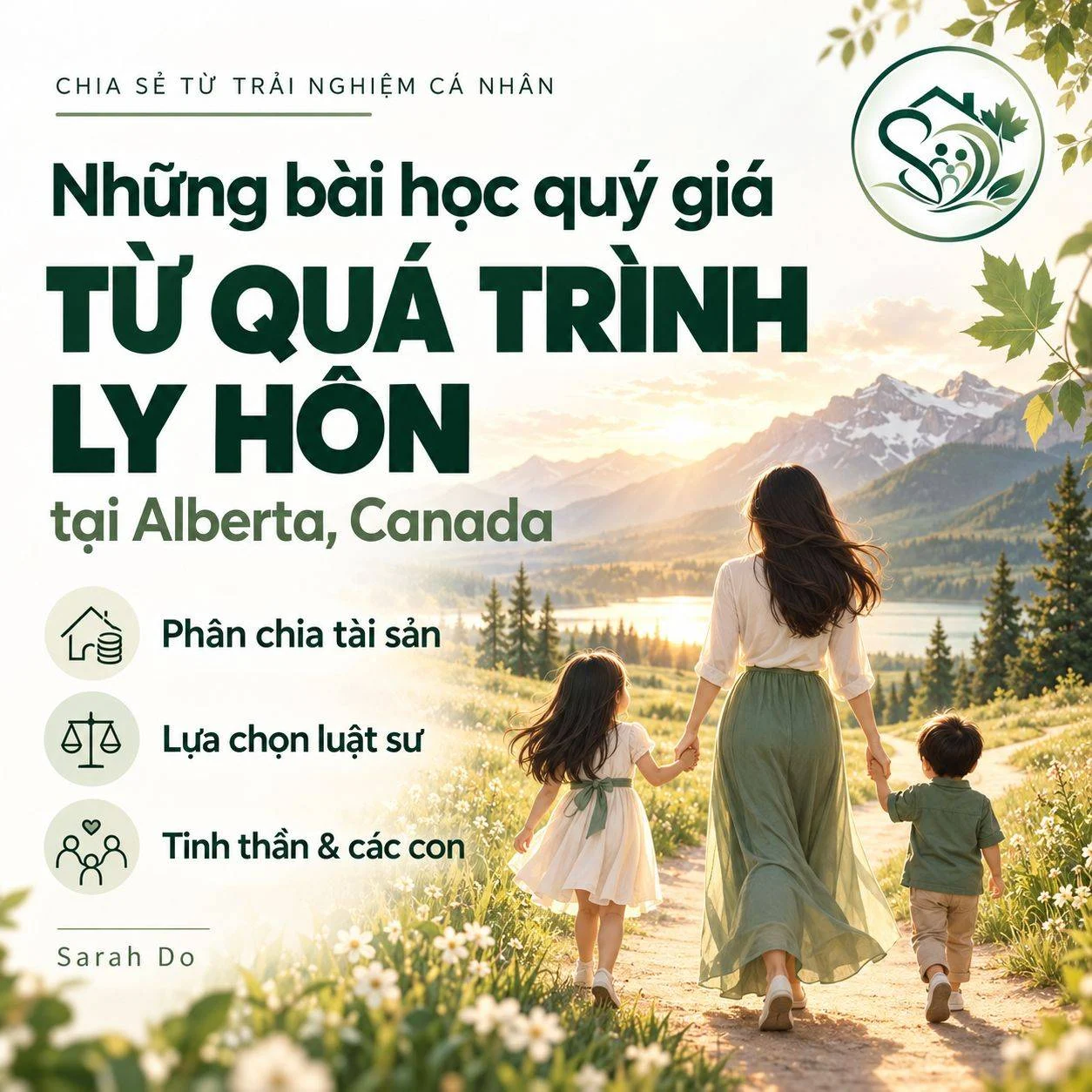
Valuable Lessons I Learned From My Divorce in Alberta, Canada
My divorce in Alberta made me realize there are many things you only understand once you have been through them: from assets that are easy to overlook, to choosing a lawyer, to the emotional toll on both mother and children. These are the lessons I drew from my own experience, and I hope they help you feel a little less overwhelmed if you are going through this stage too.

The Child Support Order Process – Part 2: Support Organizations
This article is Part 2 in the series on the process of applying for a Child Support Order, focusing on the support organizations in Alberta. I share my personal experience as a low-income parent, from applying to Alberta Legal Aid to organizations such as the Women's Centre of Calgary, the Alberta Family Resolution Hub, and the Child Support Resolution Program (CSRP). The article walks through each step in detail, from submitting an application, file assessment and advice, to mediation, reaching an agreement, or preparing for court. This is a useful guide for anyone looking to resolve a child support dispute without their own lawyer, or who wants to clearly understand the support options available.

The Child Support Order Process – Part 1: What Is Child Support?
I started writing this article while I was preparing my own application for child support in Calgary, Alberta. After months of figuring out a rather complicated process on my own, I want to record the whole experience to help anyone in a similar situation. In this series, I will clearly explain what child support is, the common misunderstandings, how it is calculated under Canadian rules, and the practical things to know when filing in Alberta. I hope this sharing will help moms (and dads too) find clearer direction on their journey to protect their children's rights.