

Free Support Services for Newcomers to Canada

When you set foot in a new country, what is usually the first thing you do to look for help? Most people ask around among acquaintances, friends and relatives. Right? Or, one level up, they hang around Vietnamese community groups asking questions. However, if your English is good, you can take advantage of many free resources from the Government of Canada. In this article, besides listing some support services for newcomers, I will write in detail about each service that I have experienced myself or have heard about.
Free services for newcomers to Canada are very diverse, and may include: finding a job, finding a mentor, learning a language, services for women, seniors, youth, LGBT, etc. Some of these services do not require you to be a permanent resident (PR), while some do. So don’t hesitate to contact them and ask even if you are not a PR yet. To find support services near where you live, go to this link: https://ircc.canada.ca/…/newcomers/services/index.asp… . After entering the postal code of where you are living, you can filter for the services you are looking for. Before going there in person, call ahead to ask for some basic information (for example: whether the service is free for people who don’t have PR yet) and book an appointment. In Canada, people book appointments for almost everything; you can’t just show up unannounced and expect someone to see you. Also, if you are not good at English, don’t hesitate to ask whether they can provide an interpreter. Below are some support services that I have taken part in or had some contact with.
𝟏. 𝐂𝐨𝐦𝐦𝐮𝐧𝐢𝐭𝐲 𝐂𝐞𝐧𝐭𝐞𝐫
A Community Center (CC) is a community support centre with a great many services, and I believe this is the first and best option you need to look into. Typically, a CC includes programs and support services for pregnant mothers (for example, prenatal classes), children (swimming lessons, skating lessons, entertainment for infants…), seniors (clubs, fitness and sports classes for older adults…), people with low incomes (guidance on sources of support for food, clothing and finances, applying for benefits)… In short, whatever help you need, they will help you with it. Besides searching for services by postal code as above, if you happen to see a CC right near where you live, just Google and go straight to their website and you will get lots of information much faster. For example, in Jane-Finch you can go to https://janefinchcentre.org and find absolutely everything there.
𝟐. 𝐓𝐨𝐫𝐨𝐧𝐭𝐨 𝐏𝐮𝐛𝐥𝐢𝐜 𝐋𝐢𝐛𝐫𝐚𝐫𝐲
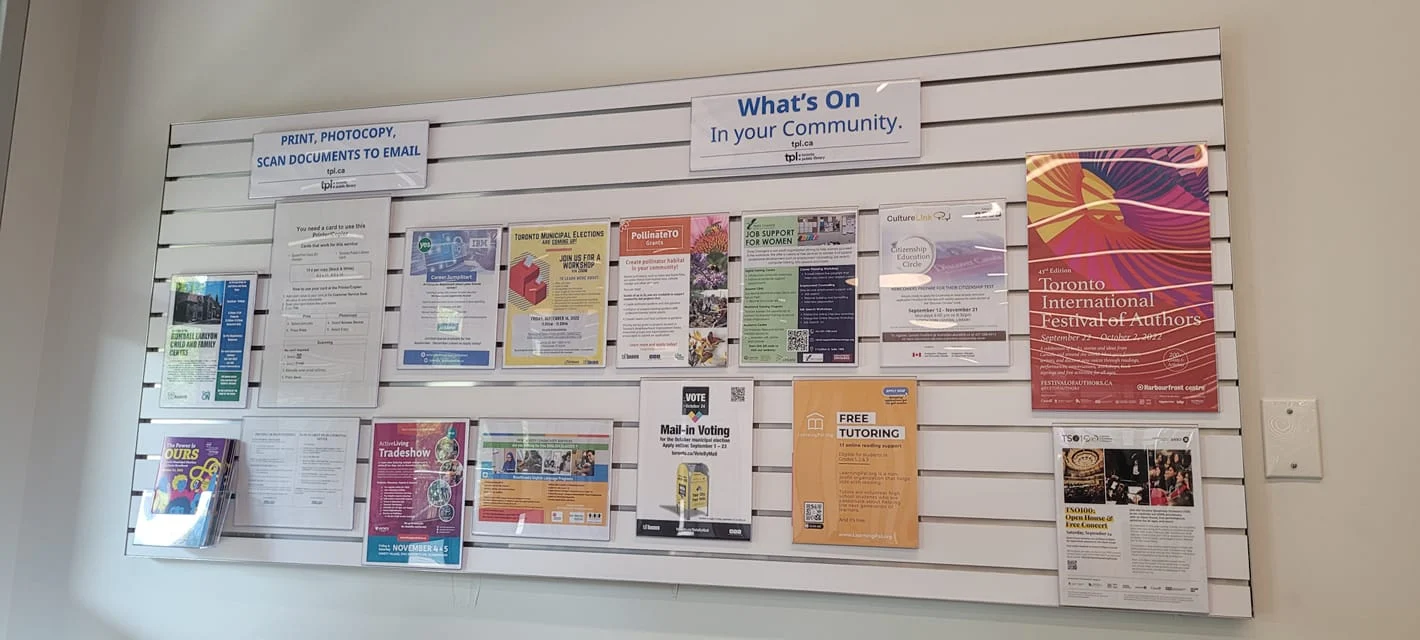
A public library is a place most of us probably think is only for borrowing books, right? But no — in Canada, libraries play an important role in “bringing knowledge to everyone”. So besides lending books and CDs for free, libraries also have book clubs, language classes (both online and in person — English, French, sign language…), basic computer classes, job-search classes, classes for people starting a business… Borrowing books or joining these programs is extremely simple. You just bring your identification (ID) and proof of your address to the nearest library to register for a free library card. Each library has different programs, so you can go to the library in person to see program information on the notice board, or view it online at the website: https://www.torontopubliclibrary.ca/ However, I recommend going to the library in person, because the information will be fuller and more up to date. Don’t be surprised if one morning you arrive at the library really early and receive a free ticket to the zoo or the ROM  Because libraries occasionally have programs giving away tickets to some entertainment and recreation venues.
𝟑. 𝐅𝐨𝐨𝐝 𝐛𝐚𝐧𝐤 𝐂𝐚𝐧𝐚𝐝𝐚
I can’t remember whether I’ve written an article about Food Bank Canada before? I’ve written so much that I don’t remember anymore Oh well, since it’s come up, I’ll write it again. A Food Bank is a charitable organization that provides food to people with low incomes. Don’t feel embarrassed about thinking you have to go get free food meant for the poor. For Vietnamese people who have just arrived in Canada with no income yet, being poor is simply the reality, right? Back in the day, I also went through a period of going to the food bank and waiting a whole hour just to get food to bring home! Save whatever you can, especially in these times of soaring prices. And don’t think that free stuff means poor quality. Sorry, but sometimes it’s even nicer than the stuff we usually buy at the market. Food banks mainly provide canned goods, dry goods (noodles, grains…), vegetables and milk… but usually not perishable items like meat and fish. Sometimes there is also milk and diapers for babies. It varies by location; it is not the same everywhere. Food banks usually borrow space at community centers or churches to distribute food once a week. To find the food bank location nearest to you, go here: https://www.torontocentralhealthline.ca/listservices.aspx…. Registering to use a food bank is usually quite simple; at some easygoing places you may not even need to register — just show up, wait, and pick up the food. At stricter places, they will ask for ID and information about your income (they only ask; they don’t require any documents to prove it). Besides these food banks, international students can also look into the food bank at their school. Colleges and universities also often have food banks.
Well, this article is already long, and the author is down with a cold today and feeling a bit tired. I’ll stop here. If I suddenly remember anything else, I’ll edit and add it in. Or if anyone has questions, leave a comment and I’ll add more in an edit, or write a whole separate article if it is a long topic. Wishing everyone a happy, worry-free “landing” 
Related Articles
Valuable Lessons I Learned From My Divorce in Alberta, Canada
My divorce in Alberta made me realize there are many things you only understand once you have been through them: from assets that are easy to overlook, to choosing a lawyer, to the emotional toll on both mother and children. These are the lessons I drew from my own experience, and I hope they help you feel a little less overwhelmed if you are going through this stage too.

The Child Support Order Process – Part 2: Support Organizations
This article is Part 2 in the series on the process of applying for a Child Support Order, focusing on the support organizations in Alberta. I share my personal experience as a low-income parent, from applying to Alberta Legal Aid to organizations such as the Women's Centre of Calgary, the Alberta Family Resolution Hub, and the Child Support Resolution Program (CSRP). The article walks through each step in detail, from submitting an application, file assessment and advice, to mediation, reaching an agreement, or preparing for court. This is a useful guide for anyone looking to resolve a child support dispute without their own lawyer, or who wants to clearly understand the support options available.
The Child Support Order Process – Part 1: What Is Child Support?
I started writing this article while I was preparing my own application for child support in Calgary, Alberta. After months of figuring out a rather complicated process on my own, I want to record the whole experience to help anyone in a similar situation. In this series, I will clearly explain what child support is, the common misunderstandings, how it is calculated under Canadian rules, and the practical things to know when filing in Alberta. I hope this sharing will help moms (and dads too) find clearer direction on their journey to protect their children's rights.