

Dependent Children Attending School in Canada

Table of Contents
- 1. What Counts as a Young Child — a "minor child"?
- 2. Which Children Need to Apply for a Study Permit in Order to Register for School in Canada?
- 3. Applying for a Study Permit
- If the child is outside Canada
- If the child is already in Canada
- 4. Tuition Fees?
- 5. School Starting Age?
- 6. Finding a School for Your Child
- 7. School Hours & Drop-off and Pick-up
1. What Counts as a Young Child — a “minor child”?
– In the provinces of Alberta, Manitoba, Ontario, Prince Edward Island, Quebec and Saskatchewan, a minor child is 17 years old or younger
– In the provinces of British Columbia, New Brunswick, Newfoundland and Labrador, the Northwest Territories, Nova Scotia, Nunavut and Yukon, a minor child is 18 years old or younger.
2. Which Children Need to Apply for a Study Permit in Order to Register for School in Canada?
Let me clarify once more: this study permit is required to “register for school” in Canada only, not “to be able to enter Canada”. The step of travelling from Vietnam to Canada is a different step. For example, a child who comes from Vietnam to Canada as a visitor — without a study permit — but whose parents are international students or workers, can still register for school in Canada without applying for a study permit. The specific cases are as follows:
– No study permit needed: Canadians, PRs, children of other nationalities accompanying parents who are Canadian/PR, children travelling alone, children accompanying a parent who is an international student or a worker, refugee children accompanying refugee parents.
– Study permit needed: children accompanying parents who are here as tourists (that is, the parents are visitors).
Although some of the cases listed above do not need a study permit, IRCC still encourages applying for a study permit for your child for the following reasons:
– The child can continue studying in Canada as the child grows older (past 17/18 years of age),
– The child can obtain a co-op work permit at the secondary school level (since some subjects at the secondary level may require work experience to complete the course)
– The child can take part in some social services in some areas.
3. Applying for a Study Permit
This section is quite complicated, so I will only summarize a few main points. Usually, to obtain a study permit, parents first need to apply for a letter of acceptance for the child -> and to get that letter you have to do step 2 that I just wrote about above. However, there are still exceptions (noted below).
If the child is outside Canada
A child entering Canada for the purpose of studying must apply for a study permit in order to enter Canada. Children entering Canada with parents who are international students/workers are the exception: they do not need a letter of acceptance to apply for a study permit.
If the child is already in Canada
A child already in Canada may be allowed to attend school without a study permit in the following cases:
– The parents are Canadian/PR
– The child is a refugee accompanying refugee parents
– The child came to Canada as a visitor to take a course of less than 6 months
– The child is in Canada alone, or is here with visitor status
– The child has a parent who is authorized to study/work in Canada (study permit holder, work permit holder, business visitor…)
If the child does not have a study permit, the child must still have valid visitor status throughout the entire time the child is in Canada.
* Note: Although it is said that no study permit is needed, how the child actually enters Canada is another story. Keep in mind that IRCC states clearly: “A border services officer makes the final decision at a Canadian port of entry about whether the minor student can come to Canada.” In other words: the border services officer has full authority to decide whether the child is allowed in or not.
Since I am currently living in Toronto, Ontario, the following sections will focus mainly on this area.
4. Tuition Fees?
In this article, I won’t discuss private school systems for the time being. Children attending elementary schools and secondary schools in the public system in Ontario are mostly free of charge. However, parents should also confirm with the school, as some schools may charge additional fees (not much) for foreign students.
If your child attends school in another province, the rules may be different. For example, the province of Alberta has some stricter rules about the parents’ status to decide whether a child can attend school for free.
5. School Starting Age?
Each province has different rules on the age at which children start school (usually from 4 or 5 years old). In Ontario, children start attending free school from age 4 (the Kindergarten level). For example, a child who turns 4 in 2022 (in any month) will start school in September 2022. Children aged 4-5 are encouraged to attend school but it is not compulsory. Children aged 6 and over in Canada must attend school. In Alberta, the age for starting Kindergarten is 5 years old. However, Kindergarten hours in Alberta are very short, only about 2-3 hours. If you want your child to stay longer, you will have to pay extra for after-school care.
6. Finding a School for Your Child
In Toronto there are 2 public school systems: the regular public schools (under the Toronto District School Board –https://www.tdsb.on.ca/) and the Catholic public schools (Toronto Catholic District School Board- https://www.tcdsb.org/). Both of these school systems are free, but to attend a Catholic school, parents need to provide a baptismal certificate for the child or for the parents. In Canada, students are also admitted by catchment area, so to find out which school’s catchment area the address where the parents are living falls into, parents go to the “Find school” section -> choose the “Address” part. That is why families with young children, when first coming to Canada, should choose to rent a home in areas with good rankings, so that their children can attend good schools.
To see the rankings of elementary & secondary schools in Canada, parents can visit: https://www.compareschoolrankings.org/. Average school rankings fall around 4-7, while high rankings are 8-10. Attending a high-ranking school is much like the selective schools in Vietnam — the kids will be under more pressure, but they will study better (or sink completely).
7. School Hours & Drop-off and Pick-up
In Toronto, children’s school hours are usually around 9:00 a.m. – 3:30 p.m. (sorry to break the news!). So busy parents who are working/studying often send their children to before/after daycare for a fee. Before/after daycare fees are around $29-38/day. To save on this fee, parents can apply for a daycare fee subsidy for their child (see my earlier article).
The school’s school bus system usually picks up children who live farther than 1.5-2 km away. If you live close to the school, parents have to take the child there themselves. The school bus is a free service provided by the school. To check whether your home address qualifies for the school bus, check at: https://busplannerweb.torontoschoolbus.org/Transportation…
I feel this article is already getting a bit long. I’ll pause here for now. Parents, if you have any further questions, please comment below.
Also, if any parents would like to know more about childcare subsidy & daycare, you can revisit my earlier article here.
[Disclaimer: these are my personal opinions. I bear no responsibility whatsoever in relation to the information in this article, nor for any results or consequences arising from decisions and actions based on the information in this article and the related comments. Please clearly cite the source when sharing]
* 𝐒𝐨𝐮𝐫𝐜𝐞:
Reference sources for sections 1-3: https://www.canada.ca/…/stu…/prepare/minor-children.html
Reference sources for sections 4-5:
https://www.ontario.ca/page/education-and-training
Related Articles
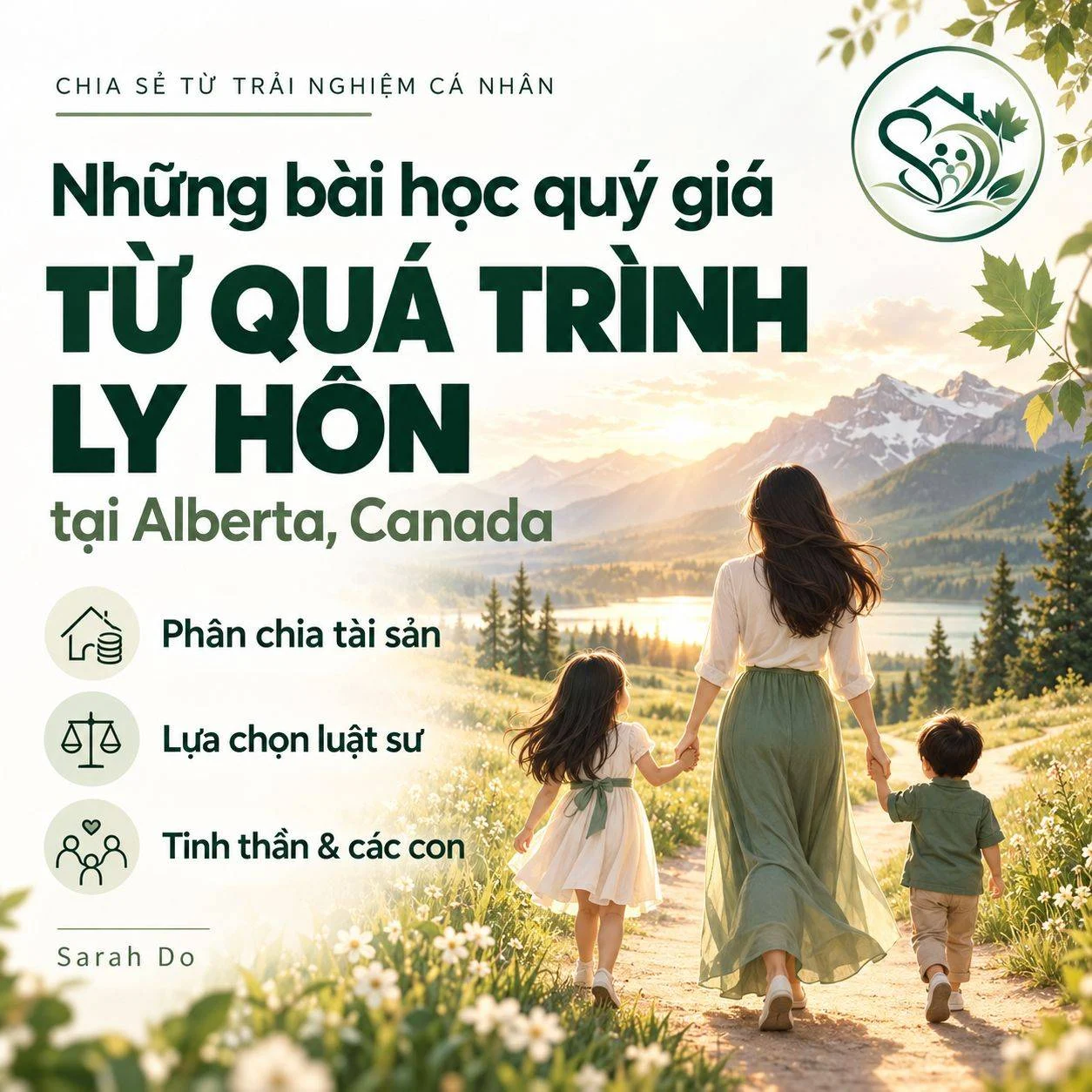
Valuable Lessons I Learned From My Divorce in Alberta, Canada
My divorce in Alberta made me realize there are many things you only understand once you have been through them: from assets that are easy to overlook, to choosing a lawyer, to the emotional toll on both mother and children. These are the lessons I drew from my own experience, and I hope they help you feel a little less overwhelmed if you are going through this stage too.
The Child Support Order Process – Part 2: Support Organizations
This article is Part 2 in the series on the process of applying for a Child Support Order, focusing on the support organizations in Alberta. I share my personal experience as a low-income parent, from applying to Alberta Legal Aid to organizations such as the Women's Centre of Calgary, the Alberta Family Resolution Hub, and the Child Support Resolution Program (CSRP). The article walks through each step in detail, from submitting an application, file assessment and advice, to mediation, reaching an agreement, or preparing for court. This is a useful guide for anyone looking to resolve a child support dispute without their own lawyer, or who wants to clearly understand the support options available.
The Child Support Order Process – Part 1: What Is Child Support?
I started writing this article while I was preparing my own application for child support in Calgary, Alberta. After months of figuring out a rather complicated process on my own, I want to record the whole experience to help anyone in a similar situation. In this series, I will clearly explain what child support is, the common misunderstandings, how it is calculated under Canadian rules, and the practical things to know when filing in Alberta. I hope this sharing will help moms (and dads too) find clearer direction on their journey to protect their children's rights.